
Boulton's Birds - Part Fourteen

TREE & SWALLOW
Designed by Enoch Boulton
by Harvey Pettitwith border artwork by Barbara Anne Lee
This is the fourteenth in a series of sixteen articles on bird patterns introduced by Enoch Boulton during his tenure as designer and decorating manager at the Carlton Works from 1921/22 to 1930.
Two Swallows make a Stunner
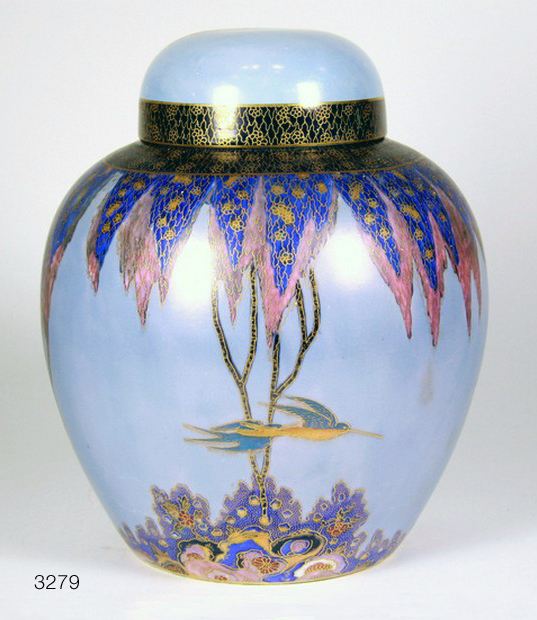
MATT GLAZE with TURQUOISE LUSTRE ground; underglaze painted; onglaze lustres;
canopy in blue and green—which sometimes fired to pink, as here; reprinted in gold.
A Transformation
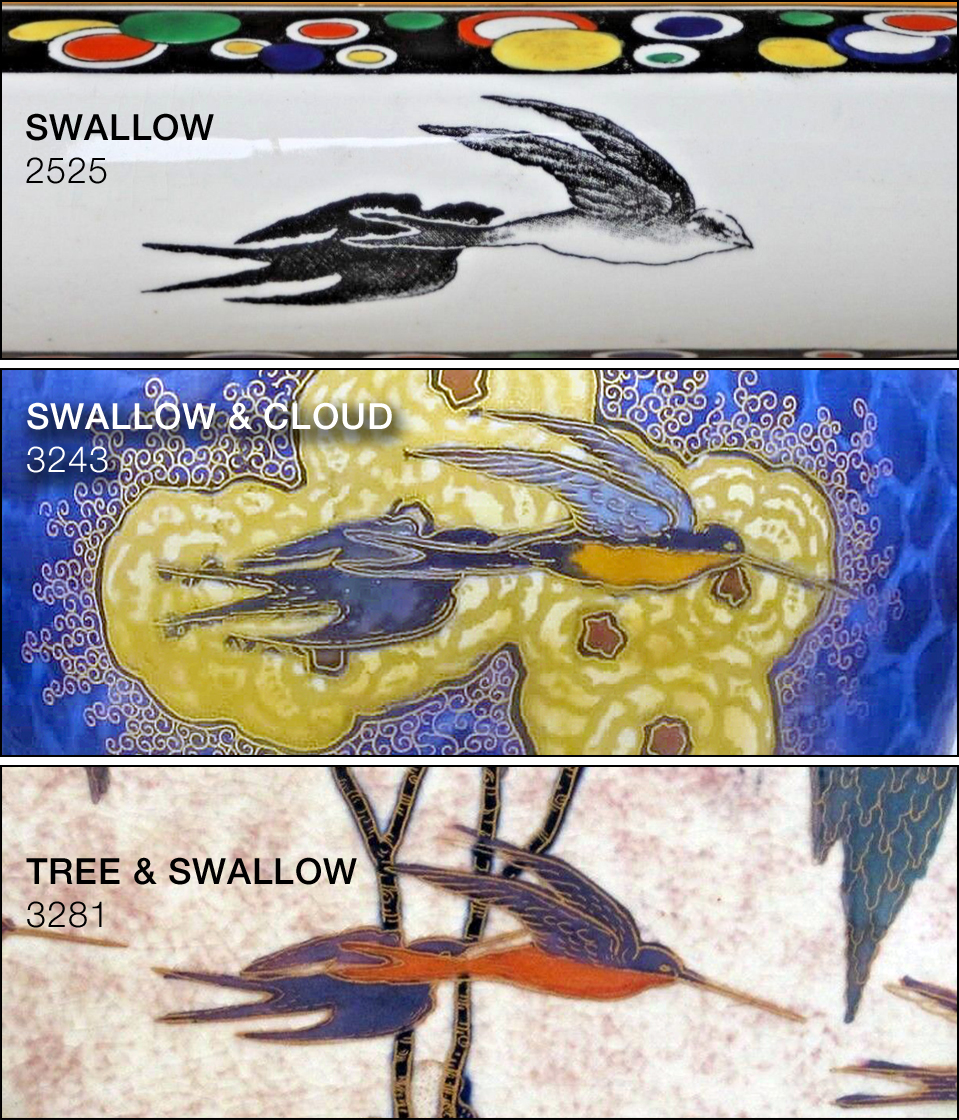
Enoch Boulton's first bird pattern for Carlton Ware was SWALLOW 2524, which was introduced around 1921/22. About three years later, the birds were adapted to make the more elaborate SWALLOW & CLOUD pattern, where the birds were given much longer beaks. Then, around 1928, these modified creatures were used again in one of Boulton's last bird patterns for the Pottery, TREE & SWALLOW, which I discuss in this article. The birds' transition and adaptation are shown below.
To return to this page, use your back button.
In all cases, the swallows were printed over their background, whether plain, the 'cloud', or the tree. It is likely that the copper plate, or cylinder from which the birds were first printed, was re-engraved to give them their longer beaks.
Some Variants
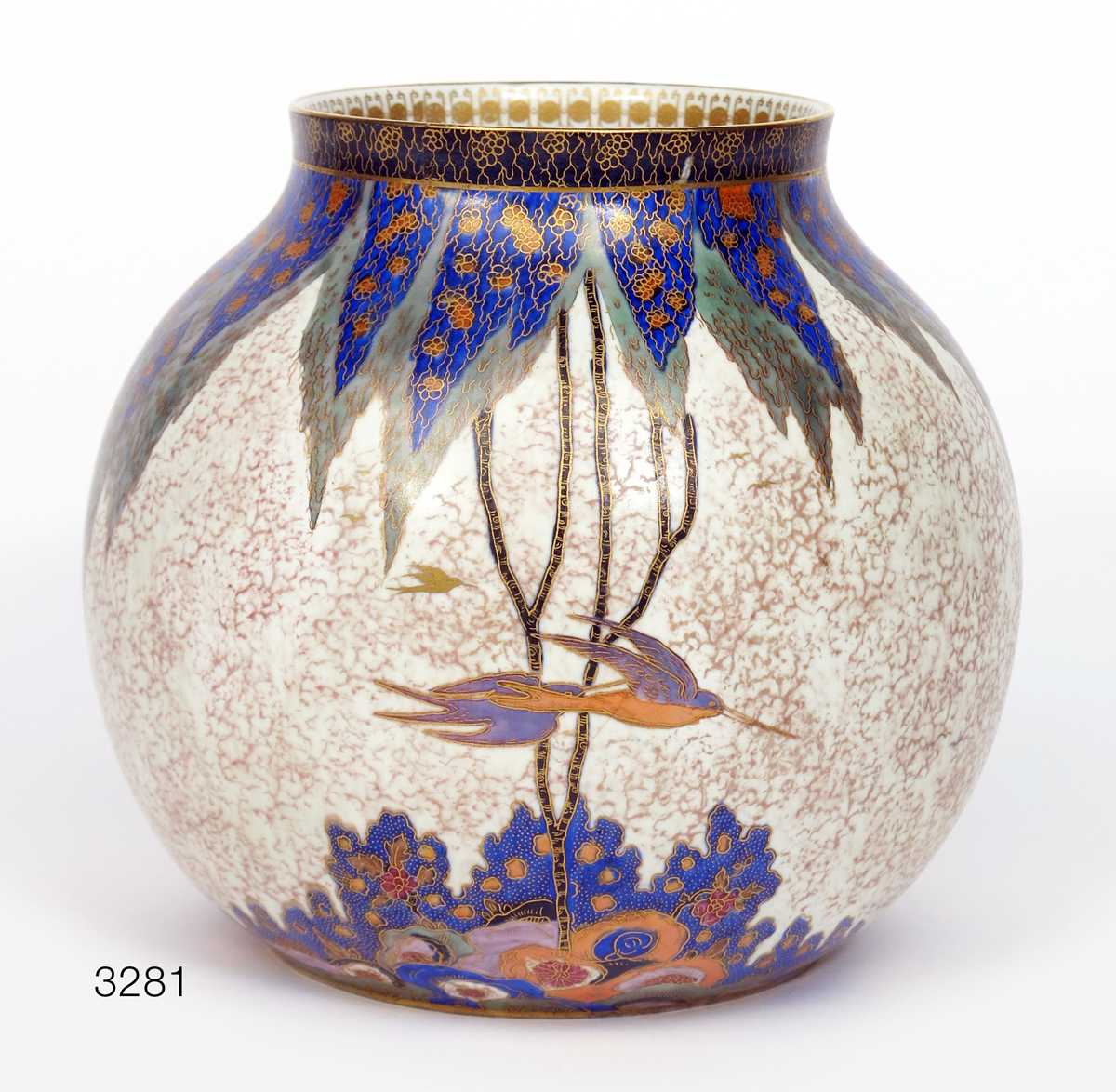
White ground stippled PINK; underglaze printed and painted; canopy in blue and green;
MATT GLAZE; onglaze lustres; reprinted in gold.
To return to this page, use your back button.
On the globular vase above, notice a tiny gold swallow, painted as if in the distance. This addition was applied by hand by the gilder to cover a tiny flaw created during one of the vase’s many firings. Firing in coal-fired bottle ovens was notoriously precarious.
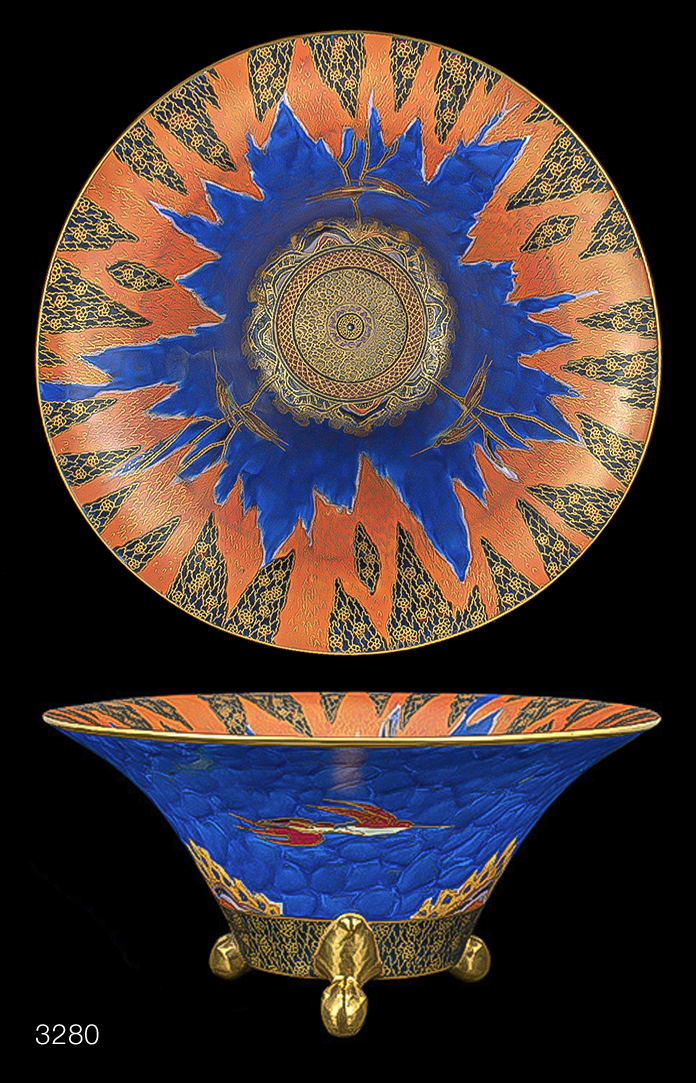
Mottled BLUE ground; MATT GLAZE; canopy in black and orange.
To return to this page, use your back button.
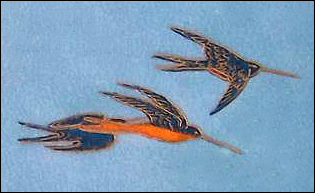
Most examples of the pattern use the two overlapping swallows, but there was another bird, as shown on the left. The third bird could be placed wherever deemed necessary.
The Canopy & Trunk
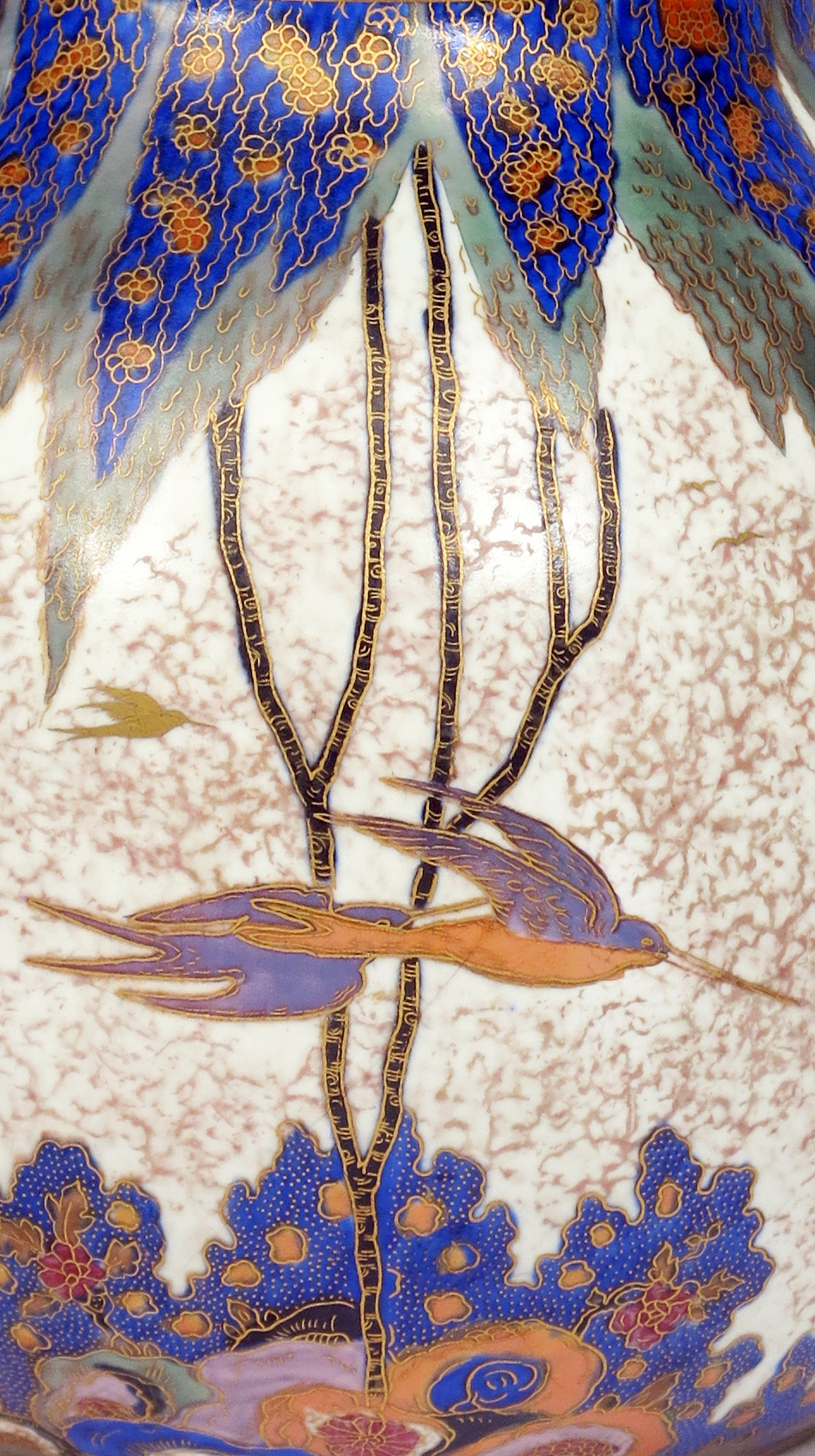
As you can see from the examples above,
the canopy is irregular. This suggests that the way in which its print was placed
onto ware was complex and a testament to the skills of Carlton Ware’s transferers.
The trunk, too, varies in shape and length, and
sometimes bifurcates in different places, again depending on available space.
An extra trunk could be added if it was thought to enhance the composition.
Again, careful placement of the various elements of the pattern was a testament to
the skill and eye of the transferers.
The Rockery or Gongshi
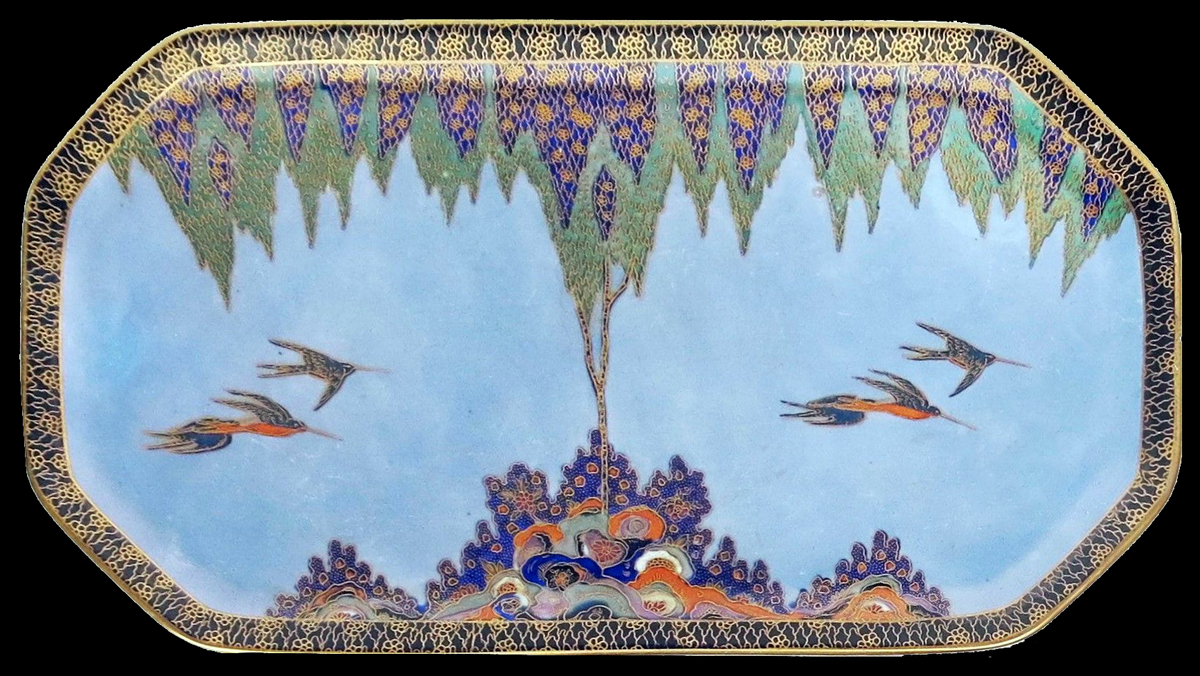
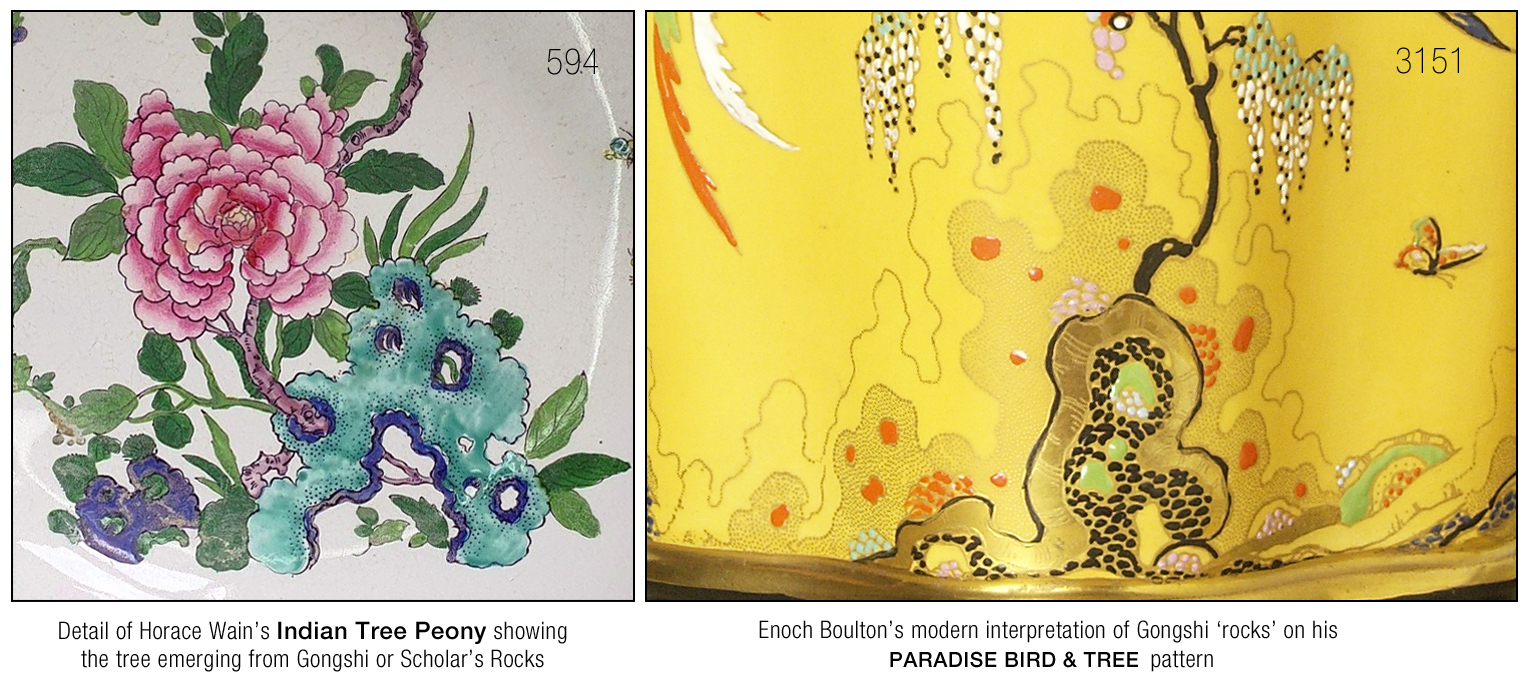
The rockery (Boulton's imaginative interpretation of Horace Wain's gongshi, copied from Chinese ceramics), from which the tree emerges, had two constituent parts, one larger than the other. The smaller was used where space was limited, or both were used where space allowed. In the image above, taken from a long dressing-table tray, the larger element is flanked by two of the smaller. Tap or click on the image to view the entire tray; use your back button to return to this page.
An Anomaly
The canopy of the tree is painted in two colours. One combination, blue and green, as used on a number of variants, has caused confusion since the green sometimes fires to pink and sometimes to a combination of both colours, all equally attractive. This suggests that the underglaze green colour was less stable than expected, its appearance varying according to firing temperature. This depended on where the ware was placed within the large bottle kilns. Examples of these colour variations are shown below.
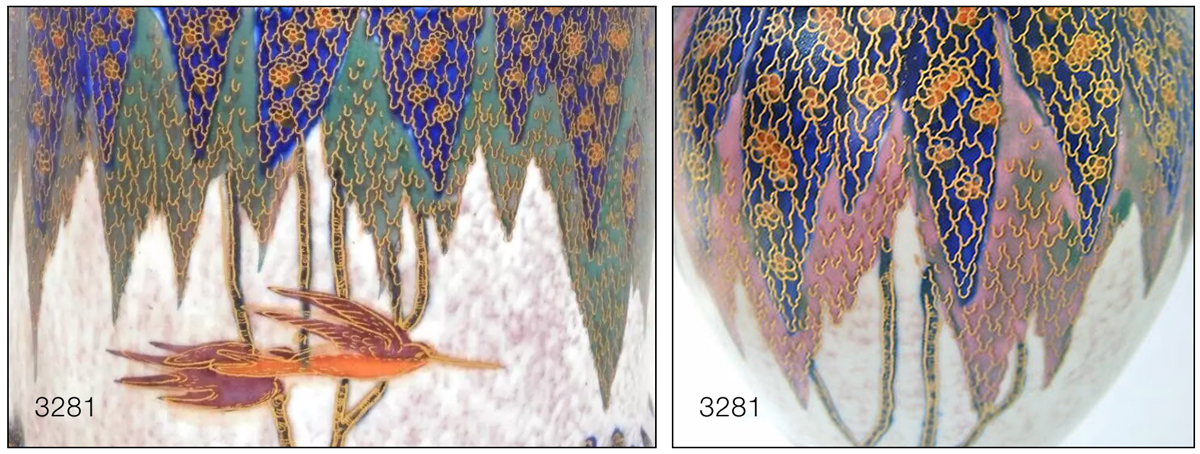
green of the canopy could sometimes fire to pink or a combination of green and pink.
To return to this page, use your back button.
The Bottle Kiln
In a traditional coal‑fired bottle
kiln,
the middle and crown are the hottest parts, while the edges are cooler.
This uneven heat was a defining challenge of bottle oven firing, requiring great skill to manage.
The fireman who controlled the kiln and its temperature was the highest paid worker on a pottery.
The image below shows placers filling the
kiln with the saggars that contained ware,
protecting it from flames, smoke, and dust. Each filled saggar could weigh 25 kilograms, so
as heavy as a bag of cement—and balanced on placers' heads!
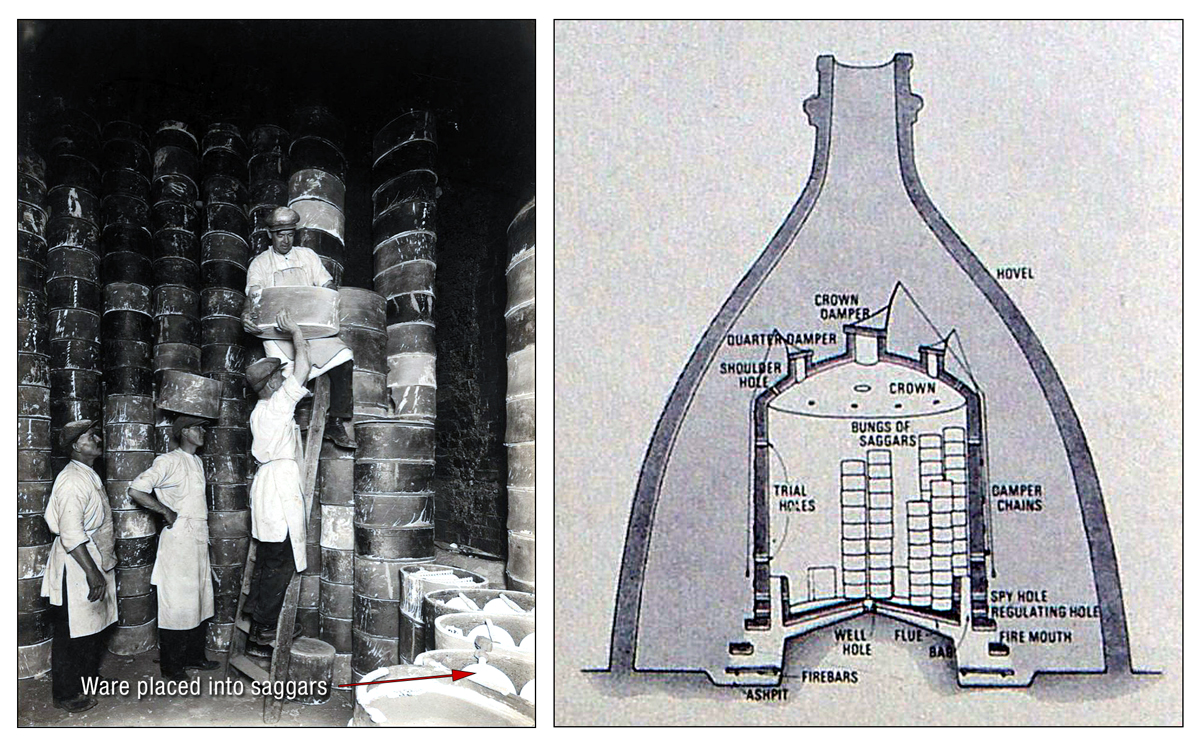
To return to this page, use your back button.
More Examples
The last recorded variant, Pattern No. 3384, was printed solely in black,
an unusual departure from the others, which were initially printed in "smoke" (pale grey) prior to the
underglaze painting and subsequently overprinted in gold. This plainer version is shown below alongside a
variant on a LEMON ground.
The black-printed version, again unusually for the pattern, has a simple, solid black border, hand-traced
in gold. The handles on this FOOTED FRUIT bowl were treated in the same way. "Finished in gold" was the
term used on the Works to describe such gilding.
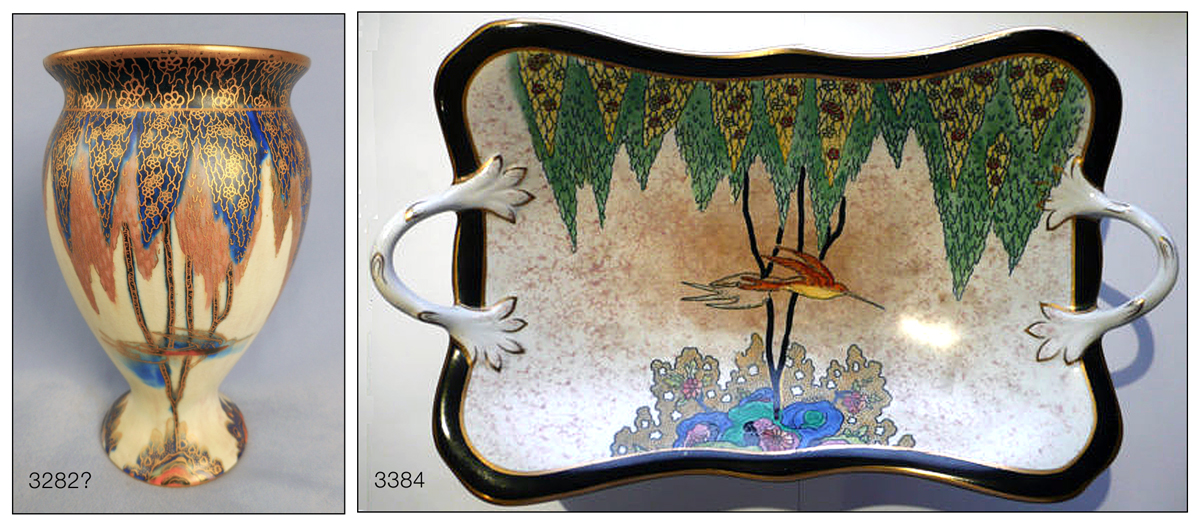
Right: TREE & SWALLOW 3384; FOOTED FRUIT S184; white ground stippled PINK.
To return to this page, use your back button.
It is curious that none of the variants of TREE & SWALLOW employed either a POWDER BLUE ground or a RUBY LUSTRE ground, two of Carlton Ware's most popular background colours, that are synonymous with the Pottery.
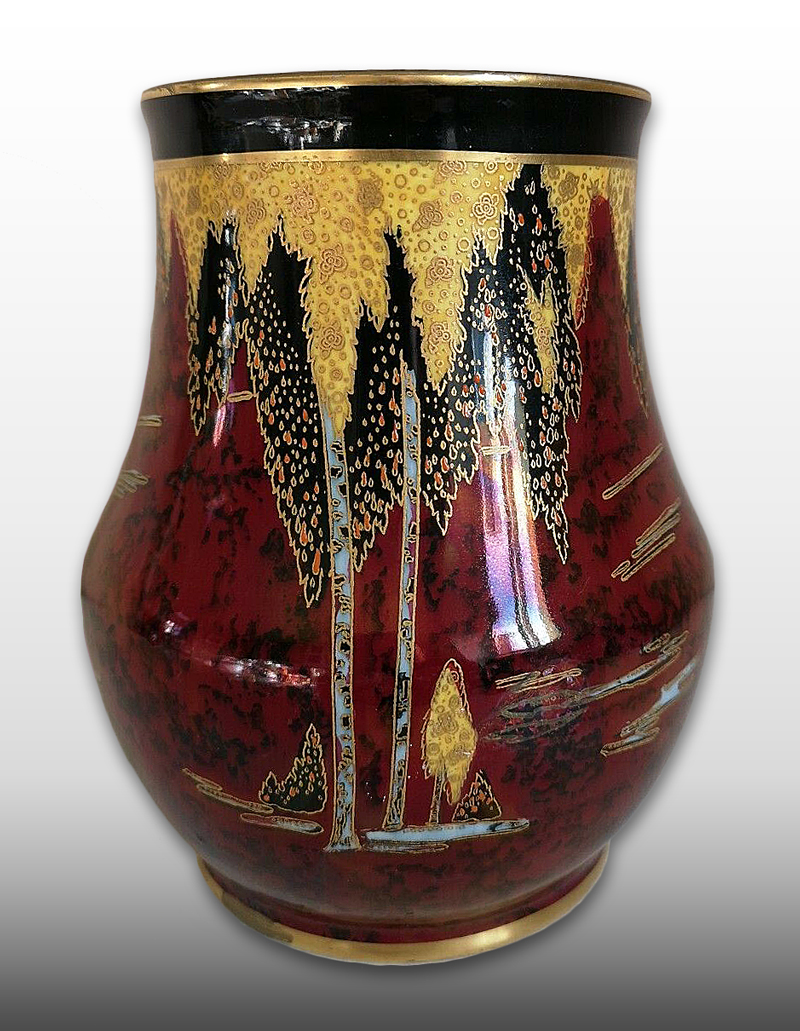
RUBY LUSTRE ground stippled black
Instead, the young designer chose to employ predominantly matt glazes,
as used on his newly introduced
HANDCRAFT
range, launched around the same time in 1928.
Perhaps this
omission can be explained by the very similar
FOREST TREE
pattern,
introduced at the same time and offered in these two most popular grounds. An example, in
RUBY LUSTRE stippled
black, with
its similar tree and canopy is shown on the right, which you can enlarge by
clicking or tapping on it.
Influences
In my earlier article (No. 11) on Boulton's PARADISE BIRD & TREE pattern, introduced in 1927, I argued that the young designer was influenced by the fairy-tale illustrations of the Danish artist Kay Nielsen, first published in 1913. In particular, Nielsen’s use of cascading foliage appears especially influential. Another example of his illustrative work is reproduced below.
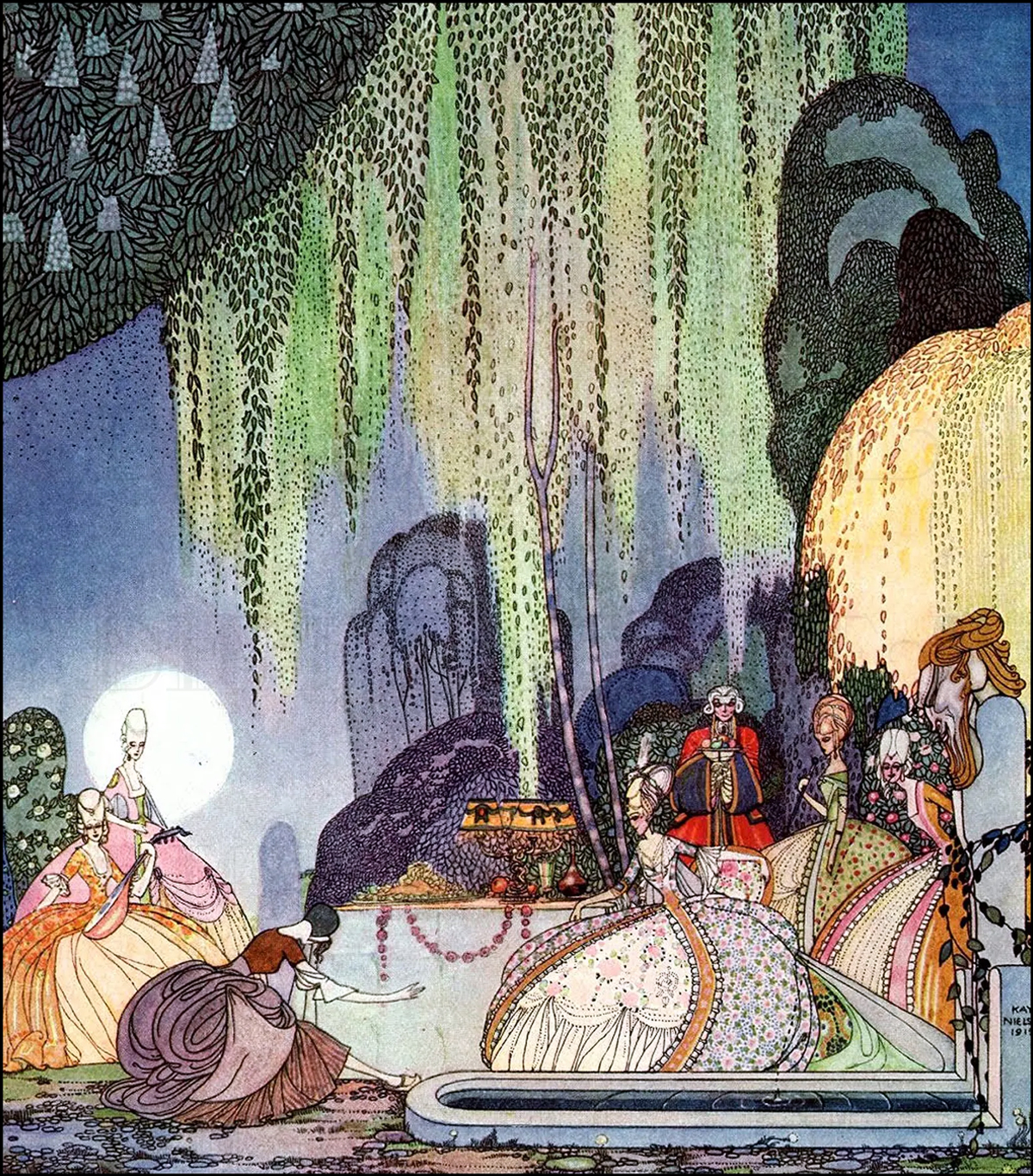
An illustration by Kay Nielsen from In Powder and Crinoline
from the fairy tale Felicia, or the Pot of Pinks compiled by Arthur Quiller-Couch 1913.
In that earlier article, I also suggested that Enoch may have been shown some of Nielsen’s drawings in books purchased by the Pottery’s owner, Cuthbert Wiltshaw, for his four young daughters.
TREE & SWALLOW Border
Boulton devised a border specifically for the pattern, namely the
TREE & SWALLOW
Border.
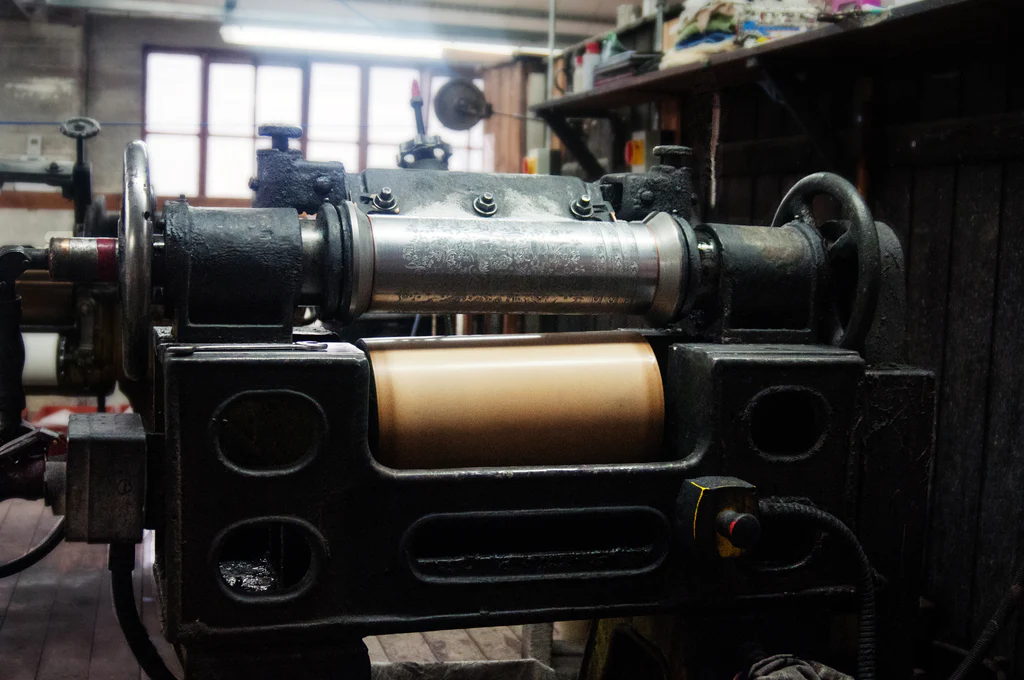
It appears to have been printed as a wide band, probably using a
printing machine with a small roller,
and, when required, cut into narrower strips.
The border is an enlarged version of the upper part of the canopy, though its flower heads
were not painted. It was just printed in gold against a black ground. Barb has redrawn the
wide band for us below, which can be enlarged by clicking or tapping on it.
 © Barbara Anne Lee 2025.
TREE & SWALLOW Border Bead
Most examples of the pattern use a narrow strip named TREE & SWALLOW Border Bead, cut from the wide band above, which Barb illustrates below.
 © Barbara Anne Lee 2025
The transferers would decide how wide a strip should be to best suit a particular shape. The ginger jar shown at the beginning of this article uses a wider strip than the narrow bead above. All known examples used the gold-printed border against a black ground.
As with many other
BEST WARE patterns, a different border was often
applied to the internal rims of vases. On the globular vase illustrated towards the top of
this page, the
WHEEL BORDER
is employed, as drawn by Barb below.
Read more about widely used ubiquitous borders.
 © Barbara Anne Lee 2023
To enlarge Barb's image of these borders and beads, click or tap on them.
Use your back button to return to this article.
Pen Stands
The TREE & SWALLOW Border was also used on the vertical edge of a triangular pen stand. According to pattern records, it was available gold-printed against the following grounds: MATT BLACK; stippled MATT RED; stippled MATT BLUE; and stippled MATT GREEN. The border was also used on a hexagonal pen stand with an AZURE BLUE ground.
Date of Introduction
The first variant of TREE & SWALLOW was probably introduced in late 1928 or early 1929. According to Violet Elmer, who succeeded Enoch Boulton as designer of Best Ware in 1930, new patterns and shapes were introduced twice yearly and promoted at trade fairs, particularly at the annual British Industries Fair held in London and Birmingham.
Availability
Carlton Ware's pattern records list twelve variants of
TREE & SWALLOW.
The first, Pattern No. 3279, is shown at the top of this article.
The last, Pattern No. 3384, was printed more simply in black only.
As with many elaborate Best Ware patterns from the 1920s
and 1930s, due to their complexity, they were discontinued by the
late 1930s—or, in this instance, earlier still, perhaps available for only a few years.
As new patterns were introduced, older designs were discontinued unless they retained
sufficient popularity. This practice kept the marque current and fashionable.
The Second World War (1939–1945) severely curtailed the production of elaborate decorations,
since many of Carlton Ware’s paintresses and other skilled employees were required to
contribute to the national war effort, whether by working in ammunition factories or by
serving as Land Girls to assist national food production.
© Harvey Pettit 2025
V1a March 2026. Minor
improvements to text, including increasing line height to
improve readability. If new or more accurate information comes to light, I will update this page.
Thanks are due to Barbara Anne Lee not only for her renderings of borders but also for her assistance in
helping us determine how both the borders and the main pattern were constructed.
The next article in this series
is about the
NEW CHINESE BIRD
pattern.