
Boulton's Birds - Part Sixteen
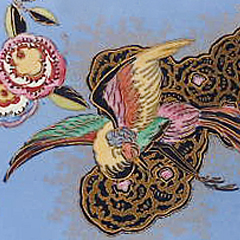
NEW CHINESE BIRD & CLOUD
Designed by Enoch Boulton
by Harvey Pettitwith border artwork by Barbara Anne Lee
This is the sixteenth in a series of seventeen articles on bird patterns introduced by Enoch Boulton during his tenure as designer and decorating manager at the Carlton Works from 1921/22 to 1930.
Every Cloud has a Gold Lining
NEW CHINESE BIRD & CLOUD
elaborates on the newly fashioned
HANDCRAFT
pattern
NEW CHINESE BIRD, which
I focused on in the previous article No.15.
It was introduced at the same time and is yet another extravagant concoction incorporating the
"cloud" motif originally devised for Enoch Boulton's earlier
SWALLOW & CLOUD
pattern from 1926.
Pictured below is the popular vase shape 406 decorated with NEW CHINESE BIRD & CLOUD 3320. This first and striking variant of the pattern employs a WEDGWOOD BLUE ground with a MATT GLAZE and a BLACK cloud.
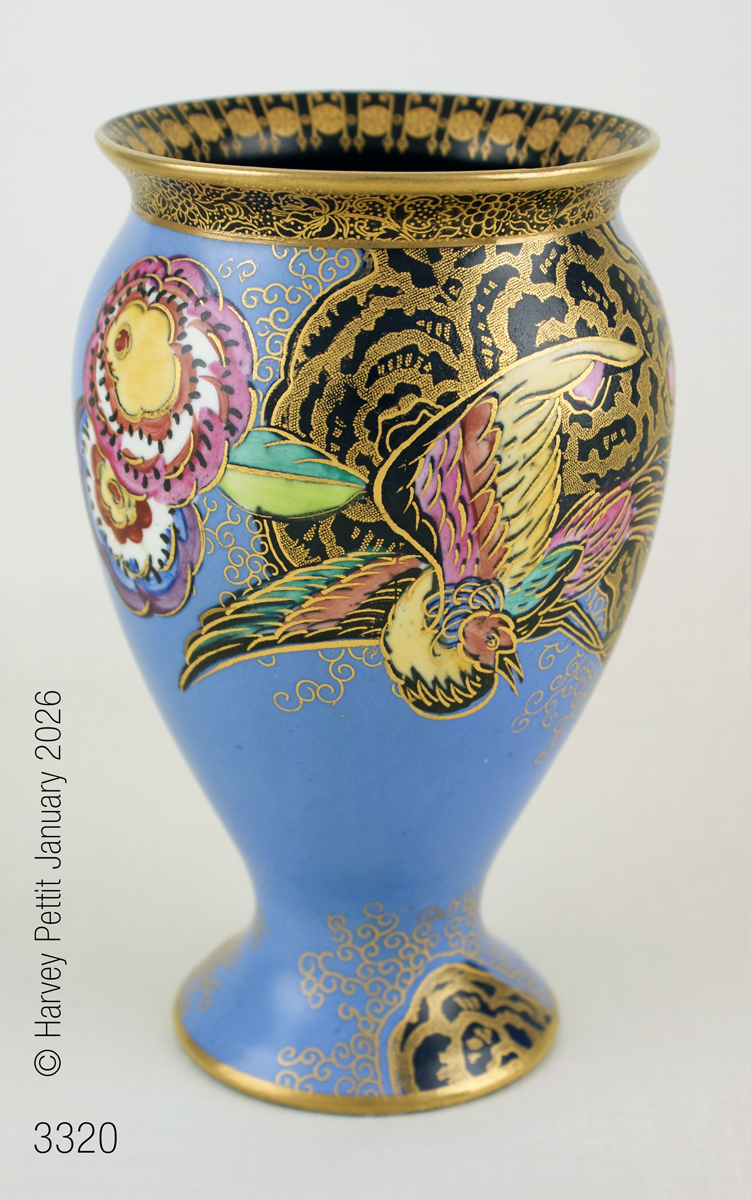
with a MATT GLAZE; underglaze printed and painted; reprinted in gold.
To return to this page, use your back button.
Out of the laboratory came beautiful colours
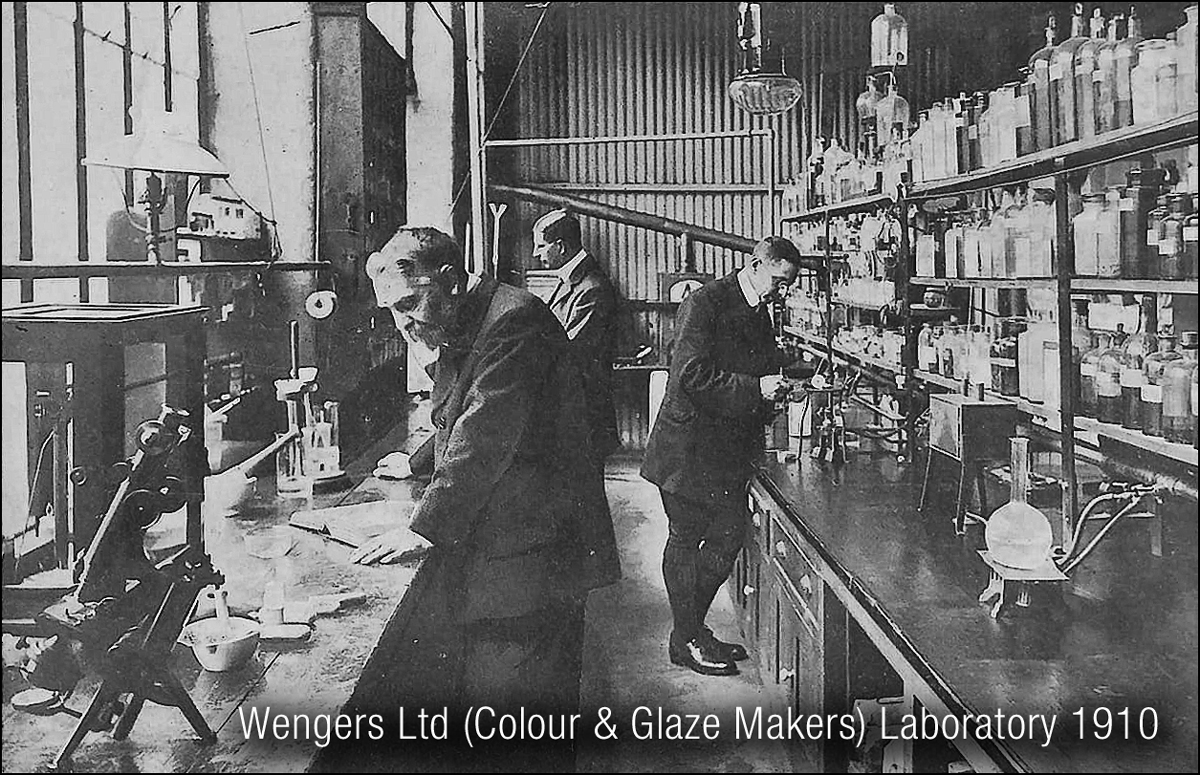
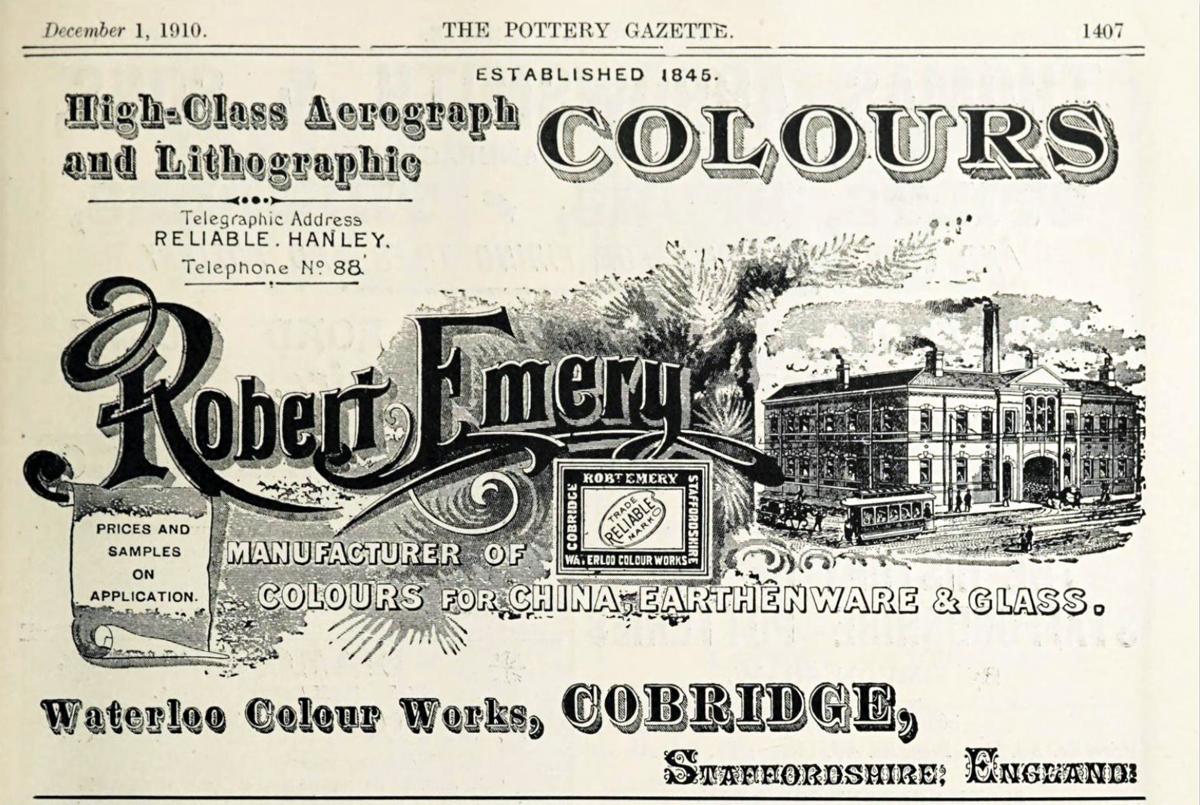
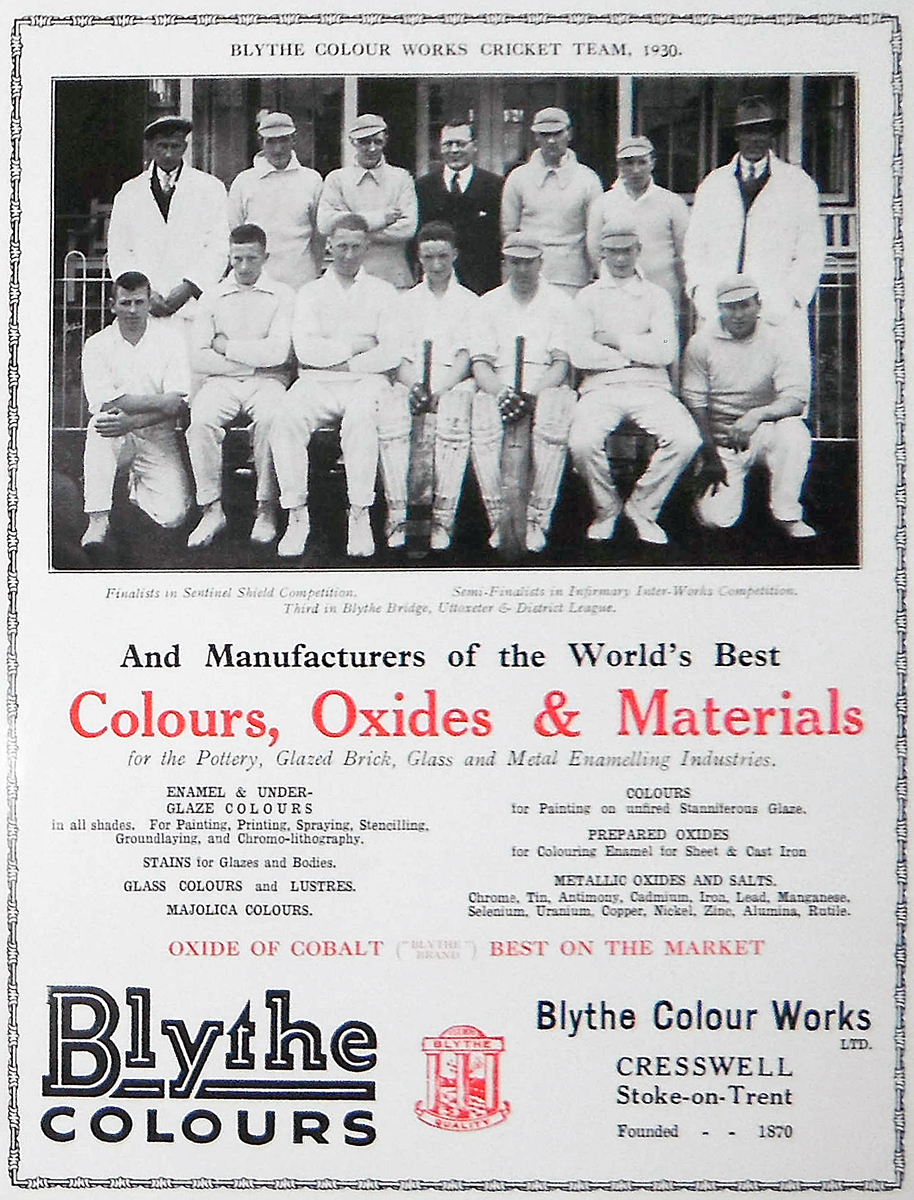
Generally, colours and glazes were bought in from one or more of the many colour makers that served the pottery industry. The development and production of glazes and colours was highly technical. The image below shows the laboratory of one such maker, Wengers. Small and medium-sized potteries did not have such resources and even the largest ones would also buy from these specialists. Emery was one manufacturer who supplied the Carlton Works; Blyth Colours was another.
To return to this page, use your back button.
Variants
Only three variants were recorded in Carlton Ware's pattern records.
The second, shown below, was assigned the consecutive pattern number 3321. As with its predecessor,
it too was given a
MATT GLAZE,
this time over a
CHOCOLATE
ground with a BLUE cloud.
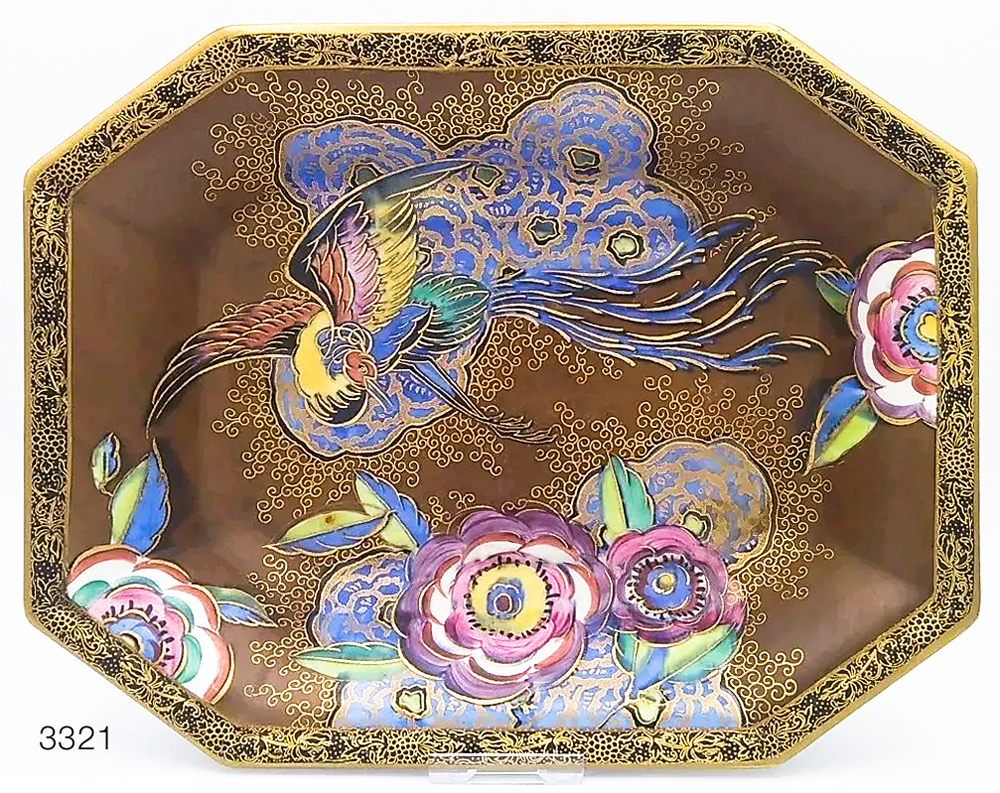
BLUE cloud; MATT GLAZE; underglaze printed and painted; reprinted in gold.
To return to this page, use your back button.
The third and last variant, pattern number 3322, uses a POWDER BLUE ground and an ORANGE lustre cloud. It is mostly decorated underglaze; the ORANGE lustre, by its nature, will be onglaze. Below, the exuberant pattern adorns a FOOTED FRUIT in a blaze of colour.
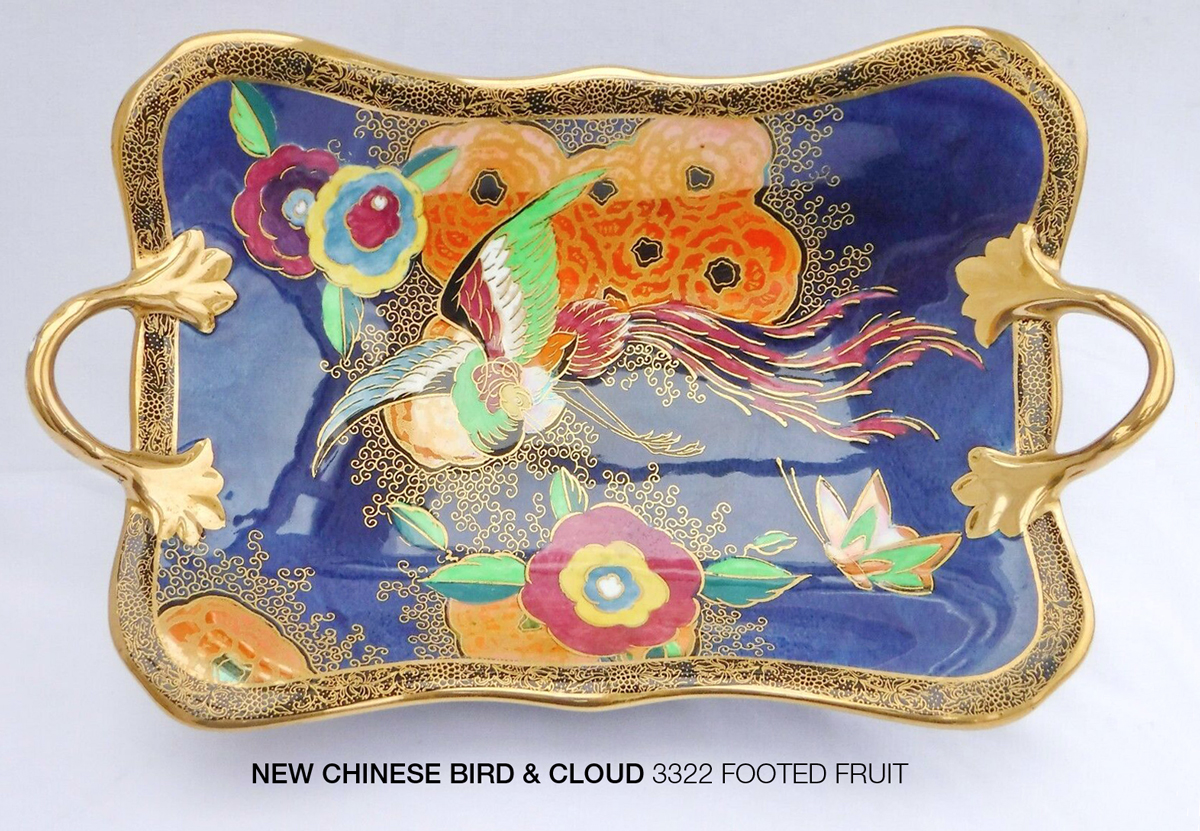
POWDER BLUE ground; ORANGE lustre cloud (onglaze);
underglaze printed and painted; reprinted in gold.
To return to this page, use your back button.
The stylised butterfly as seen on the bowl is only present on other shapes when space allows. The winged insect is not present on the OCTAGON CAKE tray with the CHOCOLATE ground shown above.
You can read about a probable source for Boulton's elaborate 'cloud' motif in my article on PARADISE BIRD & TREE with CLOUD .
Borders
NEW CHINESE BIRD & CLOUD
did not have a dedicated border, as many other patterns did.
Instead, it used the bead devised for Horace Wain's
MIKADO
pattern, namely
MIKADO BORDER BEAD; Wain
preceded Boulton as designer and decorating manager, leaving the Pottery around 1921.
Carlton Ware used the term 'bead' to describe a narrow border, often forming part of a wider one.
Barb has redrawn the bead for us below.
MIKADO BORDER BEAD
 © Barbara Anne Lee 2023
A different border was often applied to the internal rims of vases. On the vase illustrated at the top of this page, Horace Wain's WHEEL BORDER is employed, as redrawn by Barb below. Read more about widely used, ubiquitous borders.
WHEEL BORDER
 © Barbara Anne Lee 2023
To enlarge Barb's image of these
borders and beads, click or tap on them.
Use your back button to return to this article.
Date of Introduction & Availability
The three variants of NEW CHINESE BIRD & CLOUD were introduced in 1929. We can only guess how long they remained available. They may have been offered for only two or three years; certainly they would have been discontinued by the latter part of the 1930s. As new patterns were introduced, older ones were dropped unless they were particularly popular with retailers, who tended to prefer offering customers something new each season. Hence the constant stream of new patterns from the Carlton Works.
NEW CHINESE BIRD & CLOUD was Enoch Boulton's penultimate bird pattern for Carlton Ware; he was soon to leave to work for Fielding's, makers of Crown Devon, doing so either in late 1929 or early 1930.

The next and final article in this series is about the BIRD & FLOWER pattern, also known as Feathertaild Bird & Flower.
© Harvey Pettit 2026
V2 March 2026.
If new or more accurate information comes to light, I will update this page.